
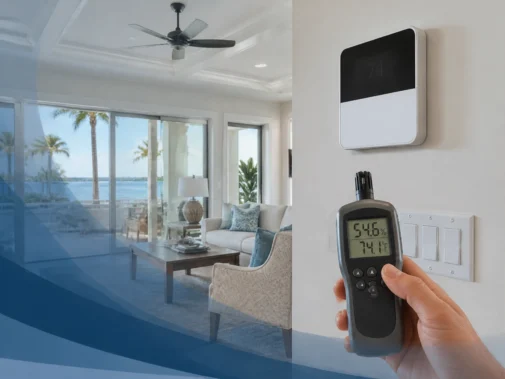
You walk into your home after a long flight, the Florida sun beating down outside, and you feel that immediate rush of cool air. You glance at the wall, and the thermostat proudly displays a crisp 72 degrees. You breathe a sigh of relief, thinking your sanctuary is safe and sound. But beneath that cool exterior, a silent battle is being waged: and your thermostat might be losing it without you even knowing.
At Blue Harbor Home Watch, we see this scenario play out far too often. Many homeowners in Naples, Florida believe that as long as the temperature is low, their home is protected. Unfortunately, "cool" does not always mean "dry." In the subtropical climate of Southwest Florida, the real enemy isn't just the heat; it’s the relentless humidity that creeps into your living spaces, hiding in your closets and settling into your upholstery.
Understanding the difference between temperature and humidity is the first step in effective Mold Prevention. As the owner and operator, I want to pull back the curtain on why your thermostat isn’t the all-knowing guardian you think it is, and why professional HVAC monitoring is essential for your peace of mind.
The Illusion of the "Safe" 72 Degrees
It’s a common misconception: if the house is cold, the mold can’t grow. This is a dangerous myth. Mold doesn't care if your home is 72 degrees or 82 degrees if the Relative Humidity (RH) levels are consistently above 60%. In fact, a cold, damp house can sometimes be more prone to mold issues than a slightly warmer, dry one.
When your air conditioner runs, it performs two distinct jobs: it lowers the air temperature (sensible cooling) and removes moisture from the air (latent cooling). However, modern high-efficiency systems or oversized units often reach the target temperature so quickly that they "short-cycle." They shut off before they’ve had enough time to actually pull the moisture out of the air. You’re left with a home that feels like a cold cave: chilly, but clammy.

Why "Cool and Clammy" is a Recipe for Disaster:
- Surface Condensation: Cold air holds less moisture than warm air. When your AC drops the temp but leaves the humidity high, that moisture is forced out of the air and onto surfaces like vents, windows, and leather furniture.
- Micro-Climates: Your thermostat only measures the air in the hallway where it’s mounted. It has no idea that the humidity inside a walk-in closet in Port Royal or a guest suite in Fiddler's Creek is skyrocketing.
- False Security: Because the display says "72," you assume everything is fine, leading you to skip a visual inspection or ignore the "musty" smell that is the first sign of a problem.
Why Your Thermostat Might Be Lying to You
You might have the latest smart thermostat, but that doesn't mean it's accurate. Most residential thermostats are designed primarily to measure temperature. The humidity sensors built into these devices are often an afterthought, and several factors can compromise their accuracy.
1. Sensor Calibration Drift
Most consumer-grade thermostats use capacitive humidity sensors that can be off by as much as 5% to 8% right out of the box. Over time, these sensors "drift" due to dust, pet dander, or simply the aging of internal components. If your thermostat is five years old and reads 55% humidity, the actual level could easily be 63%: the "danger zone" for mold growth.
2. Poor Placement Issues
Thermostats are usually placed in high-traffic hallways for convenience. However, these areas often have better airflow than the corners of your home. A reading in a breezy hallway won't reflect the stagnant, humid air trapped in your master bedroom or pantry.
3. Internal Heat Interference
The electronics inside a smart thermostat generate a small amount of heat. Manufacturers try to compensate for this with software, but it’s not perfect. This internal warmth can skew the humidity calculation, giving you a reading that is lower than the actual ambient humidity in the room.

The Blue Harbor Difference: Why We Use Hygrometers
At Blue Harbor Home Watch, we don't just "check the thermostat" and call it a day. We know that Humidity Control Naples requires a more scientific approach. This is why we utilize high-tech, calibrated digital hygrometers during our home visits.
A hygrometer is a dedicated instrument designed for one job: measuring the water vapor in the atmosphere. Unlike your thermostat, which is fixed to the wall, our portable hygrometers allow us to test the "hot spots" in your home. When we perform our Classic Home Watch services, we take readings in various zones, including:
- Behind heavy drapery and window treatments.
- Inside walk-in closets and storage rooms.
- In laundry rooms and mechanical closets.
- Near areas where the AC vents might be prone to condensation.
By comparing our professional-grade readings against your thermostat’s display, we can identify if your HVAC system is failing to dehumidify properly, even if the house feels cool.
The Cost of a "Wait and See" Approach
Many owners think they can save money by turning the AC up to 78 or 80 degrees while they are away. While this saves on the electric bill, it significantly increases the risk of a catastrophic mold event. In communities like Naples Reserve or Lely Resort, the summer humidity is relentless.
If your AC fails or the humidistat is miscalibrated, it only takes 48 to 72 hours for mold spores to begin colonizing on organic surfaces like drywall, wood, and fabric. By the time you return in the fall, the remediation costs could reach tens of thousands of dollars. Regular HVAC monitoring is the only way to catch these fluctuations before they become a crisis.

Protecting Your Investment with Proactive Care
We treat your home as if it were our own. Whether you live in Aqualane Shores, Old Naples, or Marco Island, the threats remain the same. Our goal is to provide you with total peace of mind, knowing that a professional is looking at the data your thermostat ignores.
Our Multi-Step Humidity Protocol includes:
- Visual Inspections: Checking for "weeping" vents or fuzzy growth on furniture.
- Instrument Testing: Using calibrated hygrometers to verify RH levels in every room.
- HVAC Performance Checks: Ensuring the system is cycling long enough to remove moisture.
- Immediate Reporting: If we see humidity spiking above 60%, we contact you immediately with a plan of action.
We understand that April is not the off-season for home care. As we move into the humid summer months, the stakes only get higher. Leaving your property to "self-monitor" with a smart app is a gamble. What happens to homes without regular watch after the season ends can be devastating, and we are here to ensure that doesn't happen to you.
Your Partner in Property Protection
Don't let a deceptive thermostat display give you a false sense of security. The "Humidity Battle" is won through vigilance, the right tools, and local expertise. At Blue Harbor Home Watch, we provide more than just a walk-through; we provide a shield for your most valuable asset.
From Royal Harbor to The Moorings, we are the boots on the ground that you can trust. We manage everything from basic checks to vendor coordination, ensuring that if an issue is found, it is handled by the best professionals in the business.
Are you ready for a higher standard of home watch?
Stop guessing about your home’s health. Let us provide the professional oversight you deserve. Whether you are in Hammock Bay, Port Royal, or anywhere in the greater Naples area, we are ready to help.
Contact Blue Harbor Home Watch today for a free in-home consultation. Let's make sure your home stays safe, dry, and protected all year long.