
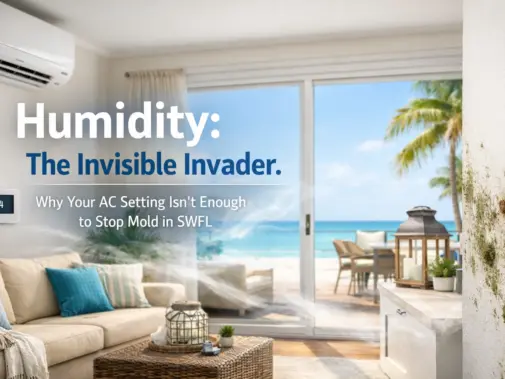
You set your thermostat to 76 degrees before heading north. Your AC is running perfectly. Everything should be fine, right?
Not in Southwest Florida.
While your thermostat happily maintains that perfect temperature, something invisible is happening inside your home. Humidity is building. Condensation is forming on cold surfaces. And mold spores are settling into the damp corners of your closets, behind furniture pushed against exterior walls, and along AC vents.
The uncomfortable truth: your air conditioning system was designed to cool your home, not to manage the relentless humidity that defines life in SWFL.
Why SWFL Humidity Is Different
Southwest Florida averages humidity levels above 70% year-round. That's not a summer problem or a rainy season issue: it's a constant reality.
From June through September, we regularly see humidity spike even higher, especially during afternoon thunderstorms and tropical systems. Your home is essentially sitting in a moisture-saturated environment, and that moisture is actively looking for ways inside.

Here's what makes this challenging: Mold doesn't need much. When indoor humidity rises above 60%, mold spores begin to settle and colonize. At 70% or higher on porous materials like drywall, wood trim, and inside closets, serious mold growth can begin in as little as 24-48 hours.
Your AC can be running perfectly, maintaining that 76-degree temperature you set, while humidity levels climb to 65%, 70%, or even higher. The thermostat doesn't care about moisture: it only responds to temperature.
The AC Limitations Nobody Talks About
Standard air conditioning systems have a fundamental design limitation when it comes to dehumidification. They remove some moisture as a byproduct of cooling, but that's not their primary function.
Several common issues actively work against you:
Oversized systems are surprisingly common in Florida homes. When an AC unit is too large for the space, it cools the air so quickly that it cycles off before the evaporator coil has time to extract adequate moisture. You get cold, humid air: the perfect environment for condensation and mold.
Short cycling means your system runs in brief bursts. Each time it kicks on, it needs several minutes just to get cold enough to start condensing moisture from the air. If it shuts off after 10 minutes, you've barely scratched the surface of dehumidification.
Duct leakage allows humid outdoor air to infiltrate faster than your system can remove it. Even small gaps in ductwork create pathways for that 75% outdoor humidity to seep into your conditioned space.
When Systems Fail: The Hidden Dangers
This is where things get serious for seasonal residents. Two common failures can turn your home into a mold factory in a matter of days.
Humidistat Failure
Many SWFL homes have whole-house dehumidifiers or humidity-sensing controls. When these fail, your AC continues to maintain temperature while completely ignoring rising humidity levels.
You won't know it happened. The house feels cool when you check in remotely via a smart thermostat. The AC is running its normal cycles. But inside closets on exterior walls, behind that couch pushed against the lanai-facing wall, and in the corners of guest bathrooms, condensation is forming.

Within 48 hours of sustained high humidity, visible mold growth can begin. Within a week, you can have a significant remediation issue.
AC Drain Line Clogs
Your AC condensate drain line carries away the moisture your system removes from the air. In Southwest Florida, these lines are prone to clogging with algae, mold, and debris: especially during long periods when the system runs continuously but nobody is checking on it.
When that line clogs, water backs up. It overflows the drain pan, pools around the air handler, and can trigger a safety float switch that shuts down your entire AC system.
Now you have no cooling and no dehumidification. In summer months, indoor temperatures can climb to 90+ degrees with humidity approaching outdoor levels within 24 hours.
The damage timeline accelerates dramatically. What might have been a minor mold issue becomes a full-blown disaster requiring professional remediation, often affecting drywall, insulation, and personal belongings.
The Cold Surface Problem
Even with a perfectly functioning AC system, SWFL homes face a unique condensation challenge that most homeowners don't realize exists.
When humid air: even at 60-65% relative humidity: contacts a cold surface, condensation forms. In your home, cold surfaces are everywhere:
- Exterior walls cooled by AC
- Supply vents blowing 55-degree air
- Ductwork running through attics and garris
- Window frames and glass during AC operation
- The back walls of closets on exterior walls
This is why mold often appears in specific locations: the corner of a closet on a north-facing wall, behind furniture against exterior walls, or around AC vents in humid rooms like bathrooms.
Your AC is working perfectly. Your thermostat reads 76 degrees. But micro-environments within your home are creating perfect conditions for mold growth.
How We Monitor Humidity Specifically
This is where professional home watch services in Naples FL and Marco Island home watch services become essential. We don't just check that your AC is running: we monitor the actual humidity levels inside your home.
During each visit, we use calibrated humidity meters to check multiple locations:
- Main living areas to establish baseline conditions
- Closets on exterior walls where condensation typically forms first
- Bathrooms and laundry rooms where moisture naturally accumulates
- Near AC vents and returns to verify proper dehumidification

We're looking for humidity readings above 60%. If we find elevated levels, we investigate immediately. Is the humidistat working? Is the drain line flowing? Are there signs of condensation on cold surfaces?
We document everything with photos and detailed notes. You receive reports showing not just that we were there, but what we found and what action we took.
Real-World Scenarios We've Caught
Last summer, we discovered a client's whole-house dehumidifier had failed. The smart thermostat showed the AC running normally at 75 degrees. But our humidity meter read 68% in the main living area and 72% in the master closet.
We identified the issue, contacted the client, and arranged for immediate repair. Without that specific humidity monitoring, the failure would have continued for weeks until they returned to find mold growth throughout their closets and bathrooms.
In another case, we found an AC drain line backup during a routine visit to a Marco Island property. The overflow hadn't yet triggered the float switch, but water was pooling in the drip pan. We cleared the clog, preventing what would have been a complete system shutdown during the hottest week of August.
These aren't rare occurrences. In SWFL's humid environment with homes sitting unoccupied for months, these failures are almost inevitable. The question isn't if something will go wrong: it's whether someone catches it in time.
Beyond Temperature: A Complete Monitoring Approach
Effective home monitoring in Southwest Florida requires understanding that temperature and humidity are separate problems requiring separate solutions.
Your smart thermostat tells you the AC is maintaining 76 degrees. That's good. But it doesn't tell you:
- Whether humidity levels are safe
- If condensation is forming on cold surfaces
- Whether the drain line is flowing properly
- If the humidistat is functioning correctly
- Whether micro-environments in closets and bathrooms are developing mold conditions
That's the difference between remote monitoring and professional home watch services. Technology gives you data. Experience gives you context and action.
We know which closets in which floor plans are most vulnerable to condensation. We recognize the early signs of drain line issues before they become emergencies. We understand how quickly conditions can deteriorate in SWFL's climate.
Protecting Your Investment
Your Southwest Florida home represents a significant investment: not just financially, but emotionally. It's your retreat, your piece of paradise, your carefully maintained sanctuary.
Mold damage from humidity issues can cost tens of thousands in remediation. But beyond the financial impact, there's the disruption, the loss of irreplaceable items, and the violation of returning to find your home compromised.
Professional humidity monitoring provides a layer of protection your AC system simply cannot. We catch the invisible problems before they become visible disasters.
Ready to protect your home with comprehensive monitoring that goes beyond basic temperature checks? Blue Harbor Home Watch provides detailed humidity monitoring and reporting as part of our regular visit protocols for properties throughout Naples and Marco Island.
Contact us for a free consultation to discuss your property's specific needs. We'll walk through your home, identify vulnerable areas, and create a customized monitoring plan that provides true peace of mind while you're away.
Because in Southwest Florida, what you can't see is exactly what you need to be watching most carefully.